
HomeInterior DesignBe told How Design Makes a Brighter Long run in This Gensler...

Be told How Design Makes a Brighter Long run in This Gensler Tome

Published on


Within the context of Interior Design’s Giants coverage, the number Gensler is most often associated with is, of course, one, given that the global entity has topped our rankings for many years running. Other digits speak to Gensler’s scope and reach: The firm has more than 6,000 staff members spread across 53 offices and 33 practice areas and last year worked on about a billion square feet of projects ranging from airports and urban plans to office-to-residential conversions in 100+ countries. Those numbers give Gensler a lot of influence but also the burden of responsibility, which it takes very seriously. The firm leads by example through its innovative design work, its groundbreaking research, its advanced eco initiatives (including the just-launched Gensler Product Sustainability Standards), and a new book penned by global cochairs Andy Cohen and Diane Hoskins.

Design for a Radically Changing World, says Cohen, “reflects the metamorphosis we all went through”—i.e., the pandemic that altered every aspect of civic life. Adds Hoskins, “We made a conscious decision to show today’s big problems in the book: the fires, the floods, the protests, the bombed-out buildings… and the human beings at the center of all those challenges.” As leaders of an industry that often struggles to articulate its own impact and superpowers, Cohen and Hoskins do just that, positing design as the discipline best poised to manifest a brighter future. We sat down with them to hear how.
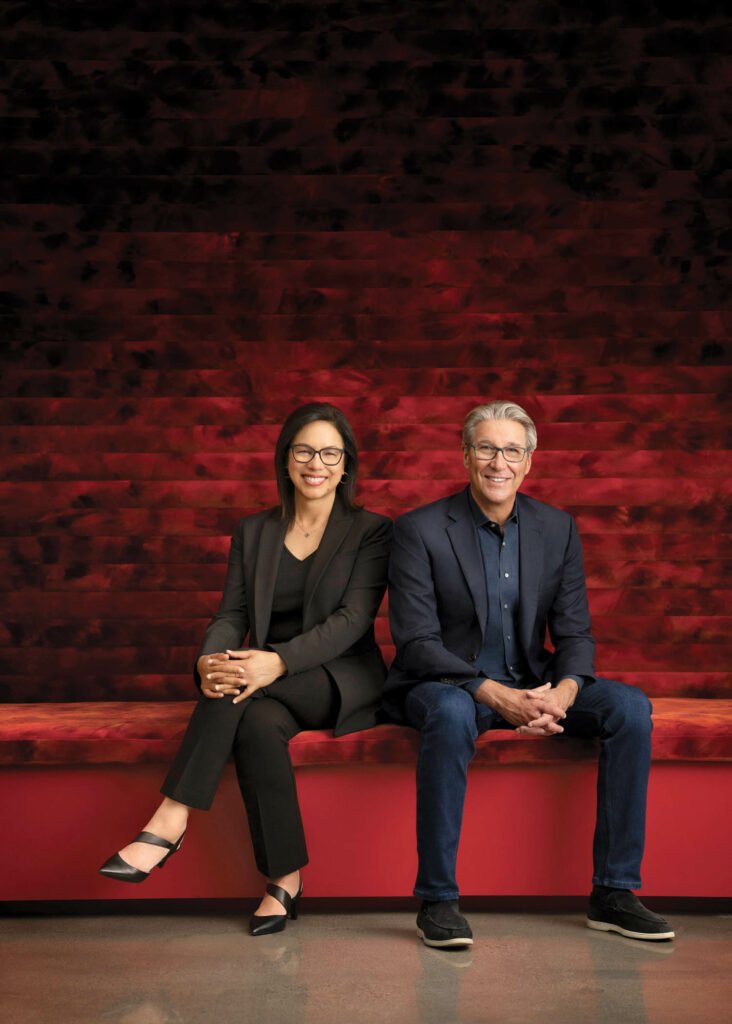
Andy Cohen and Diane Hoskins headshotAndy Cohen and Diane Hoskins headshot
Gensler global cochairs Diane Hoskins and Andy Cohen, coauthors of Design for a Radically Changing World. Photography by Cade Martin.

Gensler Global Cochairs Discuss Design + The Future

dining space with wooden themes and black tablesdining space with wooden themes and black tables
Gensler’s Atlanta office. Photography by Lauren Rubenstein.

Interior Design: Congrats on the book! Why this topic now?

Andy Cohen: We wanted to write about design’s ability to tackle the major challenges of a radically changing world head-on.

Diane Hoskins: Change is happening at such a rapid and accelerating pace, an effect we coined the “crisis multiplier” in the book. Each crisis happens so soon after the last one: climate change, COVID, geopolitical instability. It means we need to think about design very differently—and get more people to recognize that design needs to be part of the answer.

ID: What message do you want your colleagues to take away from this book?

AC: That climate change is the business imperative of our time. Nearly 40 percent of all carbon emissions is attributable to the building and construction industry. The flip side of that is: As designers and architects, we have a real opportunity to make a positive impact on climate change. Gensler’s taking a stand by committing to reducing carbon emissions in our projects by 2030.

Design For a Radically Changing world bookDesign For a Radically Changing world book
The firm’s recently released book. Courtesy Of Gensler.
chart from book Design for a Radically Changing Worldchart from book Design for a Radically Changing World
A chart from the book showing global carbon emissions by region over time. Photography courtesy Of Gensler/Data Source: The Global Carbon Project.

ID: Your discussion of A.I.’s power to reinvent the design process is intriguing. 

DH: We’ve been through new technology adoption—and the training that goes along with it—multiple times in our careers: first CAD, then Revit and parametric modeling. There is not a team in our firm that hasn’t harnessed A.I. in some way. There’s a lot of enthusiasm around how A.I. allows faster iteration; it’s like being able to apply your Pinterest board or “what-ifs” in real time. It stimulates design ideation in a way we’ve never seen before. You can bring a hand sketch into a model, and then sketch again on top of that, and A.I. will convert it to the next visualization. A.I. also has the power to remove barriers to the profession, to engage young people and unlock opportunity.

AC: And it’s not just younger generations who are interested; old guys like me have never had a tool like this that translates hand-sketches into 3D reality! We just finished a really interesting project, the Santa Clara, California, headquarters of artificial intelligence–computing company Nvidia, during which the client gave us tips for how to incorporate A.I. into our process.

ID: How are you designing today’s workplaces to be “a destination, not an obligation,” as you put it?

AC: Our workplace survey showed the top reason people want to return to the office is for focus. But research also found a 37 percent drop-off in collaboration during COVID. So, these days we’re creating a phenomenal amount of living room space where people can come together. Our redesigned San Francisco office, for instance, has become a laboratory of the future workplace, with a layering of zones. The front is like a coffee shop, with music playing; the middle is collaboration space, designed with noise-attenuation technology so you don’t hear the group sitting at the next table; and the back is a pin-drop-quiet library for focusing. 

DH: Design isn’t task work; it’s about the whole person. So, we focus on the power of presence and the innovation it sparks, and even more so on the culture, which comes from relationships and the ability to learn, mentor, and grow alongside each other. More and more companies are recognizing they’re at their best—from the standpoint of innovation, speed, accuracy, efficiency—when everyone’s present together. 
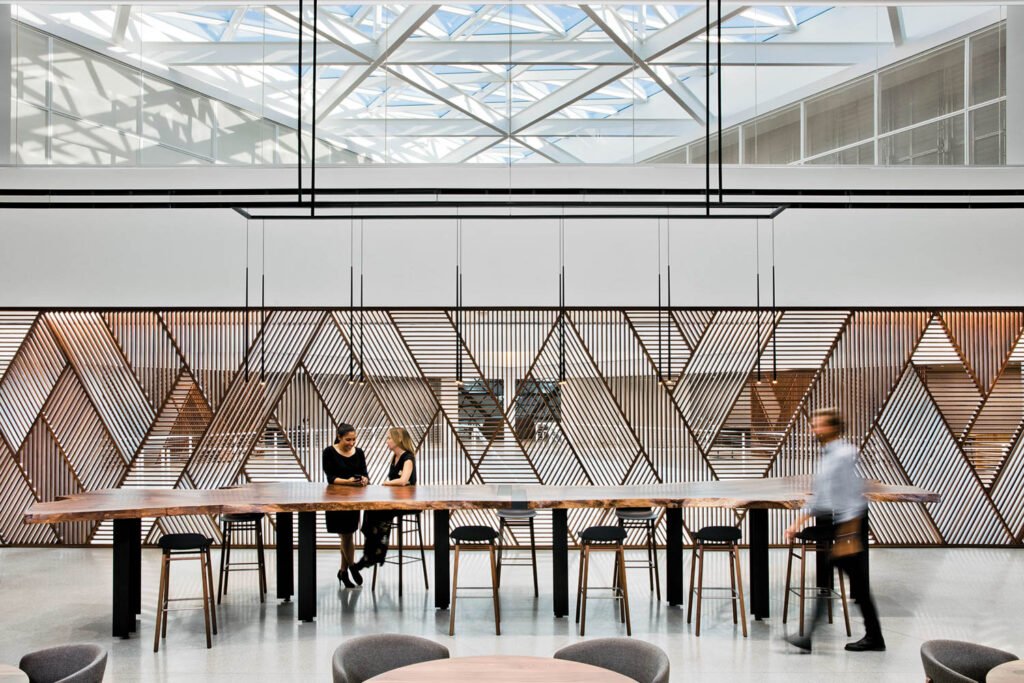
indoor dining space inside of airport with people sitting at tablesindoor dining space inside of airport with people sitting at tables
Collaboration space at Nvidia headquarters in Santa Clara, California. Photography by Connie Zhou.

ID: You highlight the importance of designing structures with built-in flexibility for different future uses.

AC: Look at all the B and C office buildings currently sitting empty, every one of which will need to be transformed through adaptive reuse. Gensler created an algorithm for cities and developers to analyze a building portfolio and determine applicability of renovation into much-needed housing. Only 25 percent of structures prove suitable, but that’s still millions of square feet. When prices drop low enough it becomes economically viable to retrofit those buildings into apartments. We just completed Pearl House, the largest such conversion to open in New York.

ID: The future of cities is a sort of sub-theme of the book. Tell us about other urban challenges you’re solving for.

DH: At the Meridian Diplomacy Forum, I met with mayors of Ukraine cities that were destroyed, to help them think through rebuilding. They know that by having a forward vision, they’re giving their people hope. Design makes hope tangible.
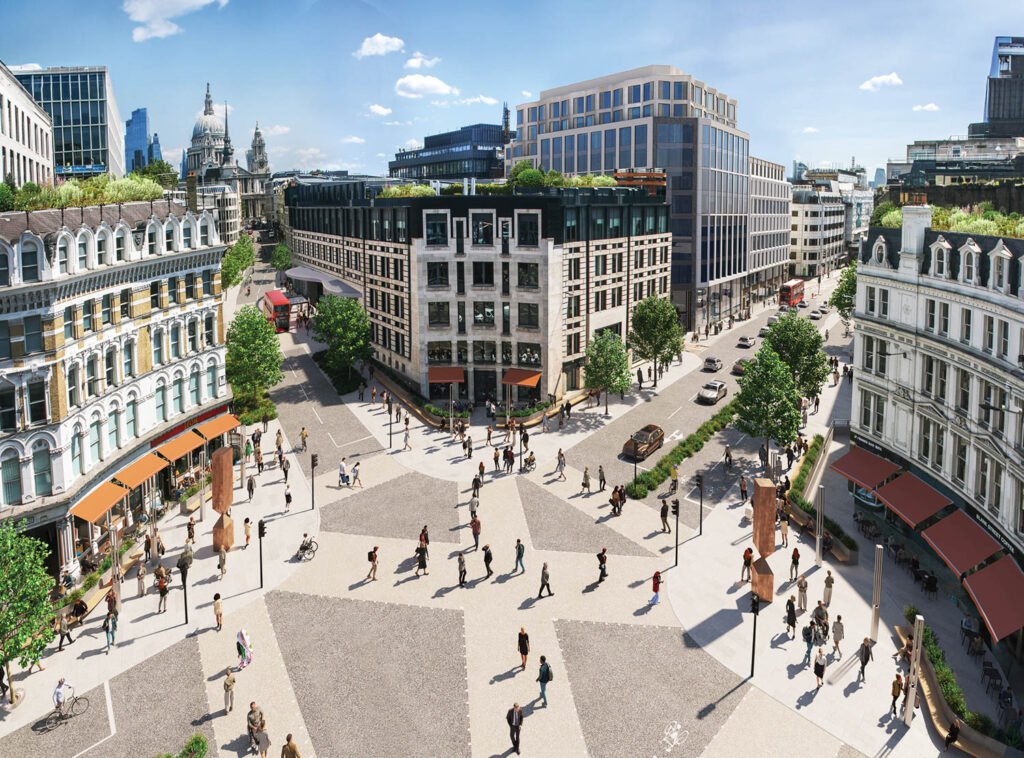
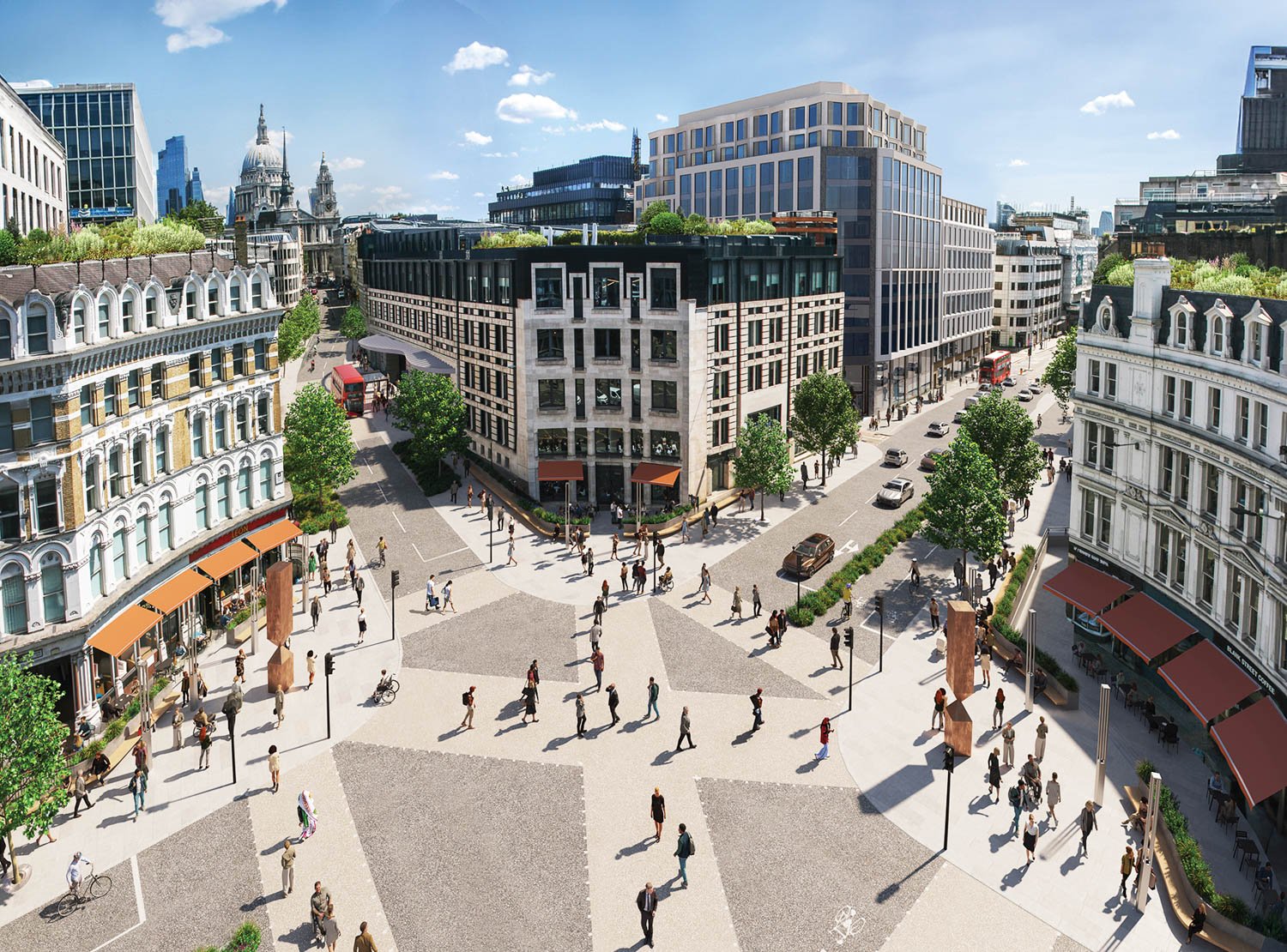
aerial view of crosswalkaerial view of crosswalk
Illustration of the proposed Ludgate Circus area of opportunity in the Fleet Street Quarter of London. Photography courtesy Of Gensler.

ID: Was it hard to find a writing voice that was optimistic yet urgent?

DH: Look, we’d still be in COVID if someone hadn’t created the vaccine. It took innovation, focus, and intensity to get to that solution. It’s within our grasp to make a difference in the world. We have this power—how the design brain connects the dots and thinks big and the collaborative nature of the profession. Our discipline is really well positioned to be the problem solvers of our time. We can do it.

airport lobby area with high ceilingsairport lobby area with high ceilings
San Francisco International Airport, Harvey Milk Terminal 1, the most energy-efficient terminal in North America. Photography by Jason O’Rear.
aerial view of airportaerial view of airportaerial view of airport
JFK International Airport, New Terminal One, in Queens, New York. Photography by Tmrw.Inc.


Source link

Latest articles

Bathroom design companies: A comprehensive guide to all the names you should know

This Australian brand has its London headquarters at Design Centre, Chelsea Harbour, where...

UOB HQ BANGKOK by Landscape Collaboration – mooool

本文由Landscape Collaboration授权mooool发表,欢迎转发,禁止以mooool编辑版本转载。 Thanks Landscape Collaboration for authorizing the publication of the project on...

International Eco-Camp of Regenerative Design – mooool

随着城市化程度日益加深,人口和需求不断增长,生物多样性正在迅速丧失。目前,全球建筑行业(包括建筑材料)的碳排放量占总排放量的40%。这一挑战要求建筑行业不仅要采取紧急补救措施,节能减排,实现绿色低碳建筑转型,还要采取更加积极的理念和设计,让建筑环境从源头转型,从可持续走向再生和再新。◆到2060年,全球建筑面积预计新增2300亿平方米,约等于目前全球建筑存量的总和。这相当于在今后40年中,地球上每34天增加一个纽约市。◆ 人类正在消耗大量的资源,远远超出了地球的极限,准确来说,人类每年会消耗1.8个地球。◆ 自1970年以来全球物种总量平均下降了69%。此外,重要的栖息地和碳汇区域也在丧失,2001-2021年,全球共损失了4.37亿公顷的森林覆盖,相当于自2000年以来,全球森林覆盖面积减少了11%,二氧化碳吸收能力减少了1760亿吨。 除了生态环境的挑战之外,孤独症、成瘾症、慢性疾病等个人身心问题和社会问题也在激增。这些复杂多维的、系统性挑战的根源在于人与三重关系的断裂:与自我的断裂,让我们丧失个人身份认同、价值观和信仰;与他人的断裂,让我们失去人际支持网络比如家人、朋友和社区;与大自然的断裂,让我们失去与土地,山脉,河流,海洋和动植物的连接。为了应对这些挑战,建筑师扮演着重要的角色,通过再生设计,将看似分离的元素和部分重新连接成一个整体,成为相互关联的生态系统。这种持久而深刻的变革力量不仅源于思维创新,更需要发自内心。再生设计实践的前提是,我们必须通过转变内在,来改变思维和工作方式,实现创造真正可持续世界所需的外部创变。再生型建筑和空间基于人对于自身内在潜力和本质的深刻理解而设计。它们与自然界的活力和智慧相一致,往往能化碳源为碳汇。人类活动本应是健康和可再生的源泉,而不是导致自然环境的破坏或退化,再生设计旨在实现这一点。为此,需要人类深入了解自然系统的复杂运作,与自然和谐共生并不断发展。再生设计对土地利用、社区发展和建筑环境的影响已经超过20年,并且定义了可持续实践的最新前沿。地球上的每个地方都具有独特的文化、社会和政治动态,这独特的背景导致成功的经验难以复制。因此深入理解各地的独特背景对于再生设计的规划、设计和发展至关重要。再生设计改变我们的思维和工作方式,从科学、历史、社会、文化的等角度揭示各个地方和社区的本质,探索我们是谁,可以共同为世界贡献什么,从而创造出真正可持续的规划设计。   <01 何为FUTURE+再生设计国际生态营?>FUTURE+再生设计国际生态营由Architecture 2030和野声WildBound联合发起,目标是培养下一代建筑与空间设计领域的领导者。该项目以再生设计原则为指导,旨在培养参与者创造出既可持续又能促进社会和生态正向发展的空间。结合U型理论的深度变革之旅,生态营提供为期五天的沉浸式体验。在这一过程中,参与者将得到行业导师和同伴的持续支持,通过头脑、心灵和双手的实践,促进再生建筑和空间设计的发展。参与者将通过音乐、艺术和静心体验,与大自然和在地文化建立深厚的联系;与国内外专家同行进行密切的交流,切磋经验技能;开展小组工作,实践新理念,深入体验再生转型之旅;在设计过程中,参与者将充分考虑本地历史、文化和自然环境,使建筑设计与当地特色相结合。最终,通过重建与自我、他人和自然的连接,参与者将在各个层面带来积极的转变。该项目将分别在四川成都铁牛村、马来西亚古晋和印尼巴厘岛举办三场培训活动。 营期设计理念再生设计(Regenerative Design)再生设计不仅仅是减少环境损害或实现可持续发展的策略,它是一种全面的设计理念和实践方法,旨在恢复和重新激活自然系统的健康、完整和动态平衡。再生设计关注的是创造出能够正向影响环境,促进生态和社会系统恢复和发展的空间和建筑。 U型理论(Theory U)本项目基于U型理论的框架,强调深度聆听、感知当前现实的深层结构,以及从最深的未来潜能出发进行创新。我们相信,通过个人和集体的内在转变,可以解锁建筑和空间设计的再生潜能,从而实现真正的可持续变革。  <02 你将与这些生态智慧&再生设计导师一起工作> Bill Reed美国绿色建筑委员会创始董事会成员LEED绿色建筑评级系统联合创始人Bill Reed是国际公认的可持续发展和再生设计领域专家,规划顾问、推动倡导者、公共演讲者、教师和作家。 他是再生设计公司Regenesis, Inc的负责人,公司主要开展再生设计、生活系统集成和行业教育。 他工作的重点是为实现综合、完整、有生命的系统设计过程而创建工作框架和管理,这项工作被称为再生发展。...

Conrad Shenzhen by SED – mooool

本文由 SED新西林 授权mooool发表,欢迎转发,禁止以mooool编辑版本转载。 Thanks SED the publication of the project on mooool, Text...

More like this

Bathroom design companies: A comprehensive guide to all the names you should know

This Australian brand has its London headquarters at Design Centre, Chelsea Harbour, where...

UOB HQ BANGKOK by Landscape Collaboration – mooool

本文由Landscape Collaboration授权mooool发表,欢迎转发,禁止以mooool编辑版本转载。 Thanks Landscape Collaboration for authorizing the publication of the project on...

International Eco-Camp of Regenerative Design – mooool

随着城市化程度日益加深,人口和需求不断增长,生物多样性正在迅速丧失。目前,全球建筑行业(包括建筑材料)的碳排放量占总排放量的40%。这一挑战要求建筑行业不仅要采取紧急补救措施,节能减排,实现绿色低碳建筑转型,还要采取更加积极的理念和设计,让建筑环境从源头转型,从可持续走向再生和再新。◆到2060年,全球建筑面积预计新增2300亿平方米,约等于目前全球建筑存量的总和。这相当于在今后40年中,地球上每34天增加一个纽约市。◆ 人类正在消耗大量的资源,远远超出了地球的极限,准确来说,人类每年会消耗1.8个地球。◆ 自1970年以来全球物种总量平均下降了69%。此外,重要的栖息地和碳汇区域也在丧失,2001-2021年,全球共损失了4.37亿公顷的森林覆盖,相当于自2000年以来,全球森林覆盖面积减少了11%,二氧化碳吸收能力减少了1760亿吨。 除了生态环境的挑战之外,孤独症、成瘾症、慢性疾病等个人身心问题和社会问题也在激增。这些复杂多维的、系统性挑战的根源在于人与三重关系的断裂:与自我的断裂,让我们丧失个人身份认同、价值观和信仰;与他人的断裂,让我们失去人际支持网络比如家人、朋友和社区;与大自然的断裂,让我们失去与土地,山脉,河流,海洋和动植物的连接。为了应对这些挑战,建筑师扮演着重要的角色,通过再生设计,将看似分离的元素和部分重新连接成一个整体,成为相互关联的生态系统。这种持久而深刻的变革力量不仅源于思维创新,更需要发自内心。再生设计实践的前提是,我们必须通过转变内在,来改变思维和工作方式,实现创造真正可持续世界所需的外部创变。再生型建筑和空间基于人对于自身内在潜力和本质的深刻理解而设计。它们与自然界的活力和智慧相一致,往往能化碳源为碳汇。人类活动本应是健康和可再生的源泉,而不是导致自然环境的破坏或退化,再生设计旨在实现这一点。为此,需要人类深入了解自然系统的复杂运作,与自然和谐共生并不断发展。再生设计对土地利用、社区发展和建筑环境的影响已经超过20年,并且定义了可持续实践的最新前沿。地球上的每个地方都具有独特的文化、社会和政治动态,这独特的背景导致成功的经验难以复制。因此深入理解各地的独特背景对于再生设计的规划、设计和发展至关重要。再生设计改变我们的思维和工作方式,从科学、历史、社会、文化的等角度揭示各个地方和社区的本质,探索我们是谁,可以共同为世界贡献什么,从而创造出真正可持续的规划设计。   <01 何为FUTURE+再生设计国际生态营?>FUTURE+再生设计国际生态营由Architecture 2030和野声WildBound联合发起,目标是培养下一代建筑与空间设计领域的领导者。该项目以再生设计原则为指导,旨在培养参与者创造出既可持续又能促进社会和生态正向发展的空间。结合U型理论的深度变革之旅,生态营提供为期五天的沉浸式体验。在这一过程中,参与者将得到行业导师和同伴的持续支持,通过头脑、心灵和双手的实践,促进再生建筑和空间设计的发展。参与者将通过音乐、艺术和静心体验,与大自然和在地文化建立深厚的联系;与国内外专家同行进行密切的交流,切磋经验技能;开展小组工作,实践新理念,深入体验再生转型之旅;在设计过程中,参与者将充分考虑本地历史、文化和自然环境,使建筑设计与当地特色相结合。最终,通过重建与自我、他人和自然的连接,参与者将在各个层面带来积极的转变。该项目将分别在四川成都铁牛村、马来西亚古晋和印尼巴厘岛举办三场培训活动。 营期设计理念再生设计(Regenerative Design)再生设计不仅仅是减少环境损害或实现可持续发展的策略,它是一种全面的设计理念和实践方法,旨在恢复和重新激活自然系统的健康、完整和动态平衡。再生设计关注的是创造出能够正向影响环境,促进生态和社会系统恢复和发展的空间和建筑。 U型理论(Theory U)本项目基于U型理论的框架,强调深度聆听、感知当前现实的深层结构,以及从最深的未来潜能出发进行创新。我们相信,通过个人和集体的内在转变,可以解锁建筑和空间设计的再生潜能,从而实现真正的可持续变革。  <02 你将与这些生态智慧&再生设计导师一起工作> Bill Reed美国绿色建筑委员会创始董事会成员LEED绿色建筑评级系统联合创始人Bill Reed是国际公认的可持续发展和再生设计领域专家,规划顾问、推动倡导者、公共演讲者、教师和作家。 他是再生设计公司Regenesis, Inc的负责人,公司主要开展再生设计、生活系统集成和行业教育。 他工作的重点是为实现综合、完整、有生命的系统设计过程而创建工作框架和管理,这项工作被称为再生发展。...